NewRust Server List is live: live players, wipes and one-click connect. List your server for free.Rust Server List is liveSee servers
How to Survive Your First Day in Rust PvP


Rust drops you on a beach with a rock, a torch and no instructions. Within ten minutes somebody will find you. Within an hour the map has sorted itself into people who built something and people who are still running around naked asking for friendship in voice chat.
The whole of day one: run inland, craft a stone hatchet and a stone pickaxe, build a 2×1, and put a sleeping bag, a tool cupboard and a locked door inside it before dark. Everything below is the detail.
This guide is the short version of what the first group did. It is written for a vanilla PvP server, the kind where nothing is handed to you and every other player is a threat until proven otherwise. Follow it and you finish your first session with a locked base, a respawn point and enough gear to start the second one from somewhere better than the beach.
Run first, gather second
The beach is the worst place on the map. Everybody spawns there, everybody knows everybody spawns there, and the people who have been playing for two days go down to the coast specifically to kill the people who just arrived.
Head inland immediately. Not at a jog while you punch trees – actually run, for a minute or two, until the coastline is out of sight behind you. You lose nothing by doing this. Wood and stone are everywhere.
What to gather, and how much
Your rock works on trees and on the loose grey stones lying on the ground. Hit the red X that appears on a tree and the sparkle on a stone node: you get noticeably more per swing, and the whole point of the first twenty minutes is to spend as little of it outdoors as possible.
Two hundred wood and one hundred stone gets you a stone hatchet. The same again gets you a stone pickaxe. Craft both before you gather anything else – they cut the time you spend exposed by more than half, and time exposed is the only thing that actually kills new players.
While you are out there, punch every hemp plant you see. Hemp gives cloth, and cloth is what the sleeping bag is made of.
Where to build

Roads, towers and open ground are where the traffic is. This is Extraction, one of my maps – the geography is custom, but the lesson is the same on any map.
Build where nobody is looking. In practice that means:
- Inside dense forest, or tucked against a rock face, rather than in the middle of a clearing.
- Away from roads. Roads are how people cross the map, and anything beside one gets seen by everybody who uses it.
- Away from the big monuments. They are loud, busy and full of armed people, and a base within sight of one is a base somebody walks past twenty times a night.
The smallest base that actually works
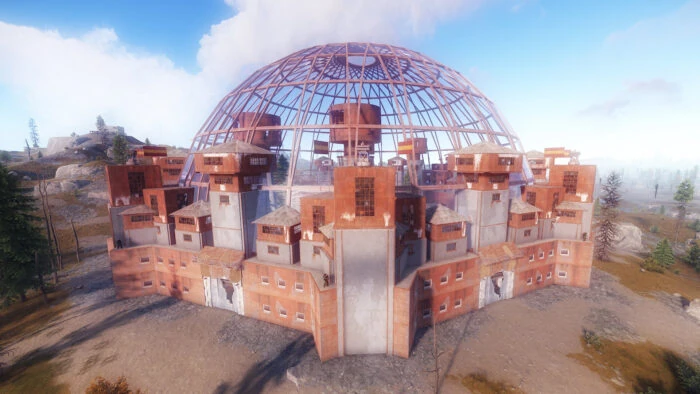
A single 1×1 box is cheap to build and cheap to break into – it has one wall between the outside world and everything you own. A 2×1 is barely more expensive and gives you room for an airlock: two doors with a small space between them, so an open outer door does not expose your loot.
Once the walls and roof are up, three things go inside, in this order:
- Sleeping bag – 30 cloth. This is your respawn point. Place it before anything else. Without it, dying sends you back to a random beach and you lose everything you have built towards.
- Tool cupboard – 1,000 wood. Authorise yourself on it and nobody else can build within 50 metres of it. Skip this and somebody will build a ramp against your wall while you are asleep.
- Door and lock – a wooden door is 300 wood, a key lock is 75 wood. A door with no lock is a door that opens for anyone.
The tool cupboard costs 1,000 wood, not 100. Several guides say 100. Gather for it before you start building, or you will finish the walls and have nothing left for the one thing that stops somebody building against them.
Upgrade the walls from twig to wood as soon as you can spare the resources. Twig breaks with a few hits from a rock. Anyone can do it, and anyone will.
Cold, hunger and the things that kill you without a gun

The arctic will kill you faster than a player will. Sea Skull, one of my maps.
Night in Rust is genuinely cold, and the snow biome is cold at any hour. A camp fire costs 100 wood, keeps you warm and cooks meat.
Build the fire inside. A camp fire outdoors at night is visible from a very long way off, and it tells everybody who sees it exactly where you sleep.
Eat before you are starving and drink from rivers rather than the sea. Both hunger and thirst tick down slowly enough that they will not surprise you, and fast enough to finish you if you ignore them for an hour.
Monuments can wait

Somewhere in here is better loot than you own and at least one person who will take yours. This is the airfield on Apocalypse Spain.
Monuments hold the good loot, which is exactly why they hold the good players. On your first day you have a stone hatchet and a bag of wood. Walking into a monument with that is a donation.
Small roadside places are worth a look once you are established. The large ones can wait until you have a bow, armour and somewhere safe to run back to.
Video guides worth your time
Two that cover the same ground in more detail, and show it rather than describe it:
Kysen, The Ultimate RUST Beginner Guide (2026).
STELIC, 20 Rust Tips I Wish I Knew Sooner.
The checklist
Before you log off on day one, you should have:
- A 2×1 base with wooden walls, not twig
- A sleeping bag inside it
- A tool cupboard, authorised
- A locked door, ideally two with a space between them
- A camp fire indoors, and cooked food
- A stone hatchet and a stone pickaxe
That is not a strong position. It is a starting position, which is the whole difference between your second session and your first: you wake up somewhere, with something, instead of on a beach with a rock.
Where the map comes in
Everything above is about the player. The other half is the ground itself – where the monuments are, how far apart they sit, whether there is cover between them, how much buildable space a hundred players have to share.
That is the part a server owner chooses, and it is what I build. If you run a server, the map decides whether new players get a chance to do any of this at all. Have a look at the maps if that is your problem rather than this one.