NewRust Server List is live: live players, wipes and one-click connect. List your server for free.Rust Server List is liveSee servers
What Makes a Good Rust Monument


Most custom monuments are beautiful and nobody visits them twice. They photograph well, they take a month to build, and after the first wipe players walk past. That is not a taste problem. It is a design problem, and it has causes you can name.
A monument is not a building. It is a fight with scenery around it. Everything below is about the fight: whether people can read the place from outside, how many ways in and out it has, whether the loot is somewhere you have to commit to, and what the whole thing costs the server.
I build these for a living, so this is what I check my own work against. It applies whether you are making one or deciding whether to put somebody else’s on your map.
It has to read from outside
Before anybody decides to go in, they look at it from four hundred metres away and decide whether it is worth the walk. That decision is made on a silhouette.

A monument that announces itself from a kilometre away: masts on a ridge, a beam, smoke. Extraction.
A good monument has one shape you can name from a distance — masts, a dome, a ship, a tower. It tells you three things without a single word: what it is, roughly how dangerous it is, and roughly how good the loot is. Players are very good at reading this and very unforgiving when it lies.
The failure is a monument that looks like a village from outside and contains an elite crate. Nobody finds it, and the people who do feel like they got away with something rather than earned it.
More than one way in, and one way you regret
A monument with one entrance is a queue. A monument with eight is a field. The number that works is usually two or three real entrances and one that costs you something — a climb, a jump you cannot undo, a tunnel with no cover.
That last one is what makes a monument replayable. It gives a confident player a way to do something the careful player will not, and it gives the careful player something to watch.
Sightlines are the actual design
Where can somebody shoot from, and where can you be shot from while you are busy? Loot in the open with a roof over it is a different place from loot in the open under the sky. Both are valid, and choosing without noticing is how you get a monument that is either a camping spot or a corridor.
Every route in needs a route out
People will not risk a place they cannot leave. If the only way out is the way in, the monument is a trap, and after one bad experience it is a monument nobody enters.
Loot you have to commit to
The rule is simple and constantly broken: the good loot goes where you are exposed.
Not behind a longer walk — behind a worse position. A crate at the top of an open stair is worth more, as a piece of design, than the same crate at the end of a safe corridor, because taking it is a decision rather than a chore.

One light source, one colour, and a room you do not want to cross alone. H1Z1 Lab.
And spread it. A monument where everything is in one room empties in ninety seconds and is then worthless for the rest of the hour. A monument where the loot is in four places has four fights in it.
Put something cheap near the entrance. It costs nothing and it gives a player who arrives with a bow a reason to come in at all — which means the monument has traffic, and traffic is what makes a monument feel alive to everybody else.
Light, sound and weather do more than detail
Detail is the most expensive way to make a place feel like somewhere, and it is the least effective.

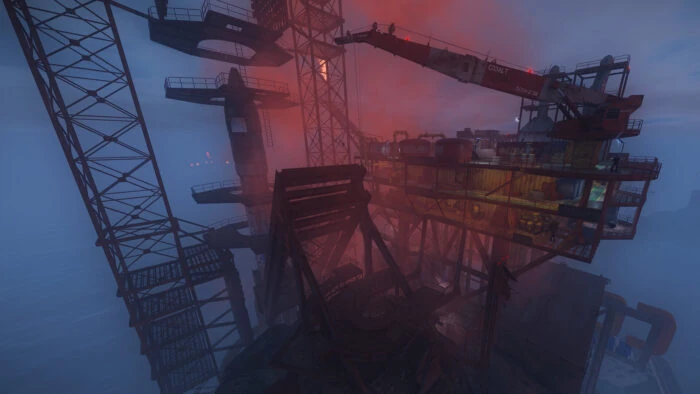
Fog does more for tension than any amount of detail. Volcanic Research.
Fog, a single strong light colour, a sound that carries — these cost almost nothing and change how a place feels completely. A room lit blue is a different room. A monument you can hear before you can see is a monument you approach carefully.
The corollary matters for performance: you can get atmosphere without prefab count, and prefab count is what your buyers pay for in server performance.
What it costs the server
This is the part that separates a monument people can use from a monument that is only a portfolio piece.
- Prefab count is fixed background load, paid every second the server is up, by every player.
- Entity count is the number that actually decides server FPS. A normal plan starts visibly struggling somewhere around 150,000 to 200,000 entities, and a wipe adds to that all week.
- Stacking monuments is where it goes wrong. One heavy custom monument is usually fine. Four on the same map, each fine on its own, is a server at 18 FPS on a Saturday night.
If you are buying a monument, ask the author for the prefab count before you buy, and run
ent countandserver.fpson your own server after a day with it in. An author who does not know the number has not measured it, and that tells you something too.
The mistakes I see most
Built for a screenshot
Symmetrical, beautiful, no cover anywhere. It is a plaza, and a plaza is somewhere people die crossing rather than somewhere they fight.
Too big
A monument bigger than a fight has dead space in it. Two players in a huge monument never find each other. Scale to the number of people who will realistically be in it at once, which is usually two to six.
No landmark inside
If you cannot say “meet me at the crane”, the inside has no map. Every monument needs two or three things you can name from anywhere inside it.
Themed instead of designed
A theme is a reason to look. It is not a reason to return. The theme should decide what the walls look like, not whether the place works.
The checklist
- It has a silhouette you can name from four hundred metres
- Two or three ways in, and one that costs something
- Every way in has a way out
- The best loot is in the worst position
- Loot is in three or four places, not one
- Two or three landmarks inside that people can name
- You know its prefab count, and so does anybody you sell it to

Two mouths, rails curving in, and a sign. You know what it is and where it goes before you arrive. CHRONUS.
That train station passes on the first one alone: two mouths, rails curving in, and a sign. You know what it is and you know it goes somewhere before you have taken a step towards it.
If you would rather not build one
Building a monument properly takes weeks, and most of those weeks are spent on the parts nobody photographs. If that is not how you want to spend them, mine are here, along with the prefabs and the maps they were built for.