NewRust Server List is live: live players, wipes and one-click connect. List your server for free.Rust Server List is liveSee servers
Rust Electricity for Beginners: Power, Batteries and Wiring


Your base is finally safe enough to keep, and now you want lights that come on at night and a turret at the door that shoots whoever is not on the list. Then you open the crafting menu and find solar panels, batteries, splitters, branches and a wire tool, with no word on how any of it fits together. Rust electricity looks like engineering. For a small base it is mostly addition.
Every device needs a fixed amount of power, every source makes a fixed amount, and a battery stores the difference for later. Add up what your devices draw, pick sources that cover it day and night, put a battery in between, and use branches rather than splitters when devices need different amounts.
This guide is for players wiring their first base. It covers the power sources and what each really gives, the three batteries, how to use the wire tool, how to share power between devices, a first circuit with turrets and lights, and the mistakes almost everyone makes once. The figures were checked against Facepunch’s own item pages and item data verified for the November 2026 build.
How power works in Rust
Power in Rust is measured in rW. A source makes so many rW, and a device needs so many rW to work. An auto turret needs 10 rW; a ceiling light needs 2 rW. Give a device less than it needs and it does not run.
Power flows one way, from a source’s output to a device’s input, through wires you place with the wire tool. Many devices also have a passthrough output that hands on whatever they did not use, so a ceiling light fed 10 rW passes 8 rW on to the next light.
Batteries are measured in rWm, power for a minute. A battery holding 24,000 rWm can give 100 rW for 240 minutes, or 10 rW for far longer, because the faster your devices draw, the faster it drains.
The power sources
- Large Solar Panel: up to 20 rW. Free power, but only in daylight, and the amount depends on how strong the sun is and its angle to the panel. Workbench Level 1, made from 5 high quality metal and 1 tech trash.
- Wind Turbine: up to 150 rW. The strongest free source. Output follows the wind, and wind is stronger higher up, so it belongs on a tall tower or a hill. Workbench Level 2.
- Small Generator: 40 rW. Steady power day and night, burning low grade fuel. It has Force Start and Force Stop inputs, so a switch or timer can run it only when needed. Workbench Level 2.
- Water Wheel: about 30 rW from flowing water, for bases by a river. Workbench Level 1.

The Large Solar Panel, the cheapest source and the one most bases start with. Image: Facepunch Studios.
The only fuel generator you can craft is the small one. The Biofuel Generator added in October 2026 sounds like another source, but it makes low grade fuel, not electricity: it turns raw or spoiled meat into fuel and needs stirring by hand about every half hour. Paired with a small generator, it can keep one running without trips to the Outpost.
Power from the roadside poles
Since the August 2026 update, the power poles with transformers along the roads can feed your circuits once the island’s Power Plant is running. A powered pole can be climbed by jumping at it, and a wire from your base can be connected to it. Facepunch made these wires keep a minimum slack, so they sag like real cables.

Facepunch's picture of the roadside poles that can power a base since August 2026. Image: Facepunch Studios.
How much a pole gives depends on how much power the Power Plant is producing, which depends on heavy fuses that players install and that wear out. Facepunch did not publish one fixed number, so treat the grid as a bonus and keep your own source. Since November 2026 one of the new phone numbers tells you the current state of the grid.
Batteries, and how long they last
A battery takes power in, stores it, and gives it out up to a maximum rate. It is what turns daytime solar into night-time light.
- Small Rechargeable Battery: gives up to 15 rW, stores 400 rWm. Workbench Level 1.
- Medium Rechargeable Battery: gives up to 50 rW, stores 9,000 rWm. Workbench Level 2.
- Large Rechargeable Battery: gives up to 100 rW, stores 24,000 rWm. Workbench Level 2.

The Medium Rechargeable Battery, made small enough in 2024 to fit under a half wall. Image: Facepunch Studios.
Each one has a Fully Charged output that sends a signal when it is full, which you can use to switch off a generator. Two details catch people out: a battery needs at least five seconds of charge before it will give anything back, and it does not return everything it takes in. Charging is listed at up to 80% efficiency.
To work out how long a battery lasts, divide its capacity by what your devices draw. Two turrets and four ceiling lights draw 2 × 10 + 4 × 2 = 28 rW. A full large battery runs them for 24,000 ÷ 28 = about 857 minutes, a little over 14 hours. A small battery could not run them at all: it gives out at most 15 rW, less than the 28 they need.
Wiring with the wire tool
The Wire Tool costs 2 high quality metal at Workbench Level 1. With it in your hands, every electrical item shows its inputs and outputs as small handles.
- Aim at the output of the thing that gives power and click it.
- Aim at the input of the thing that needs power and click it. The wire is placed.
- To cancel a wire you are placing, hold the right mouse button.
- To remove a finished wire, click one of the handles it is connected to.
The game only lets you join things that can be joined: an output to an input, never an input to an input. If a click does nothing, you are almost certainly aiming at the wrong handle.
Sharing power: splitter, branch, combiner, switch
One source rarely feeds just one device. Four cheap parts decide where the power goes. The first three are Workbench Level 1 items made from metal fragments:
- Splitter: one input, three outputs. It divides the power equally between the outputs you actually connect. 30 rW into a splitter with three wires gives 10 rW on each.
- Electrical Branch: takes a set amount off the main line and sends it out of Branch Out; the rest carries on out of Power Out. You set the amount on the branch itself.
- Root Combiner: adds two power sources together into one output, for example two solar panels. It only accepts things that produce power, not the output of a switch, splitter or branch.
- Switch: a plain on/off between a source and whatever comes after it.
The difference between a splitter and a branch matters as soon as devices need different amounts. Put 24 rW into a splitter feeding two turrets and a light: each output gets 8 rW, and both turrets stay off. Use branches instead: one branch sends 10 rW to the first turret, the next sends 10 rW to the second, and the 4 rW left over light two ceiling lights.
A first circuit: turrets and lights
A layout that works for a small base and teaches you everything above:
- Sources: two large solar panels on the roof, facing the open sky, joined in a root combiner. That is up to 40 rW in good sun.
- Storage: the combiner’s output goes into a large battery.
- Turrets: from the battery’s output, a branch set to 10 feeds the first auto turret, and a second branch set to 10 feeds the second.
- Lights: the remaining Power Out goes to a ceiling light, and each light’s passthrough feeds the next.
- Control: a switch before the lights lets you turn them off during the day, which leaves more for the turrets.
Now check the sums. The load is 28 rW all day and all night, but two panels give at most 40 rW and only while the sun is high, and the battery keeps back part of what it receives. That is enough for evenings, not for a turret line that never sleeps. Adding a wind turbine to the combiner chain, or a small generator that a Fully Charged signal switches off, is what closes the gap.

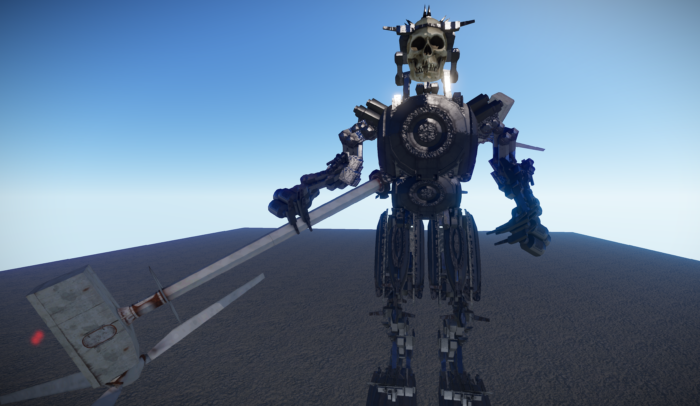
A powered auto turret firing: it shoots anyone who is not authorized on it. Image: Facepunch Studios.
An auto turret shoots every player who is not authorized on it, including your teammates. Authorize everyone in your group on every turret before you power it, and remember it needs a weapon and ammo inside, and only covers a 180-degree arc in front of it. Since October 2026 NPCs can also walk into player buildings and open doors, so a powered turret is worth more than it used to be.
Common mistakes
- Solar with no battery. Your lights go out exactly when you need them.
- Splitters everywhere. Equal shares only work when the devices need equal amounts. Use branches for anything else.
- A turret on too little power. Under 10 rW it does nothing at all.
- Wind turbines on the ground. They work, but far below what they can give high up.
- Generators left running. A small generator burns fuel for as long as it is switched on. Stop it with Force Stop or a battery’s Fully Charged signal.
- Forgetting the battery’s own losses. Plan sources for more than your devices draw, not exactly the same.
- Relying on the grid. Pole power falls as the Power Plant’s fuses wear out.
The checklist
- You know what each device draws: 10 rW per auto turret, 2 rW per ceiling light.
- Your sources cover that total with room to spare, day and night.
- A battery sits between sources and devices, sized by capacity divided by draw.
- Branches feed devices that need different amounts; splitters only where shares are equal.
- Only power sources go into a root combiner.
- Every turret has a weapon, ammo and every teammate authorized.
Where Badgyver comes in
I make custom Rust maps and plugins. Everything in this guide is vanilla Rust and works the same on a custom map as on a procedural one: the sun, the wind and the batteries do not care who made the island. If you want a server to try your first circuit on, the free Rust server list on this site is a good place to look, and if you run one, my custom maps are where I put the work.