NewRust Server List is live: live players, wipes and one-click connect. List your server for free.Rust Server List is liveSee servers
Rust Base Designs That Actually Survive a Raid


No base in Rust is unraidable. Enough explosives open anything, and somebody always has enough explosives. That is not the bar.
The job is to make your base cost more to open than it holds. Everything below is about raising the price of the cheapest way in — because the cheapest way in is the only one anybody uses.
The numbers here were checked in September 2026. Facepunch retunes them, so treat them as the shape of the problem rather than as gospel, and check a live raid calculator before you bet a wipe on a figure.
The soft side myth that opens bases for free
The single most expensive misunderstanding in Rust building, and almost everybody has it backwards.
- Explosives do the same damage to both sides of a wall. Four C4 is four C4 whether you are stood inside or outside. There is no discount for the soft side.
- Melee does roughly ten times more on the soft side. That is the real difference, and it is enormous: a stone wall takes about eight pickaxe hits per point of damage from the hard side, and does over a point per hit from the soft.
So a soft side facing outwards is not “slightly weaker”. It is a wall somebody can open with a tool, for nothing, quietly, while you are asleep. Check every outward-facing wall of your base. One wrong one is the whole base.
The soft side is the patterned face — the one with the frame and the bracing visible. The hard side is smooth. Stand outside your own base and look at it. If you can see the pattern, so can a raider with a pickaxe.
What things cost, and what they cost to break
The tiers, so you can see where the value is:
Walls
- Stone — 500 HP, 300 stone. About 2 C4, 4 rockets or 10 satchels.
- Sheet metal — 1,000 HP, 200 metal fragments, no workbench needed. About 4 C4, 8 rockets or 23 satchels.
- Armoured — 2,000 HP, and around 8 C4. The top tier, and priced like it.
Note what that means: going from stone to sheet metal doubles the raid cost for 200 metal fragments. It is the best value upgrade in the game and most people leave it too late.
Doors
- Sheet metal door — 150 metal fragments, no workbench. Around 4 satchels.
- Garage door — 600 HP, 300 metal fragments and 2 gears at a level 2 workbench. Roughly 2 C4 or 3 rockets, and no soft side at all, so it costs full price from either direction.
The garage door is the best-value thing in a base. Double the metal of a sheet metal door and two gears, for more than double the health and no soft side to exploit. Put one on the room that matters.
Honeycomb, and why half of it is worse than none
Honeycomb is a ring of extra compartments around your core, so a raider blowing a straight line inwards pays for three walls instead of one.
It works. What does not work is honeycombing one side, and that is what most people do — usually the side facing the road, because that is the side they think about.
Raiders always attack the cheapest face. Partial honeycomb does not raise your raid cost; it just tells them which wall to hit. If you cannot afford to honeycomb the whole thing, build a smaller base and honeycomb all of it.

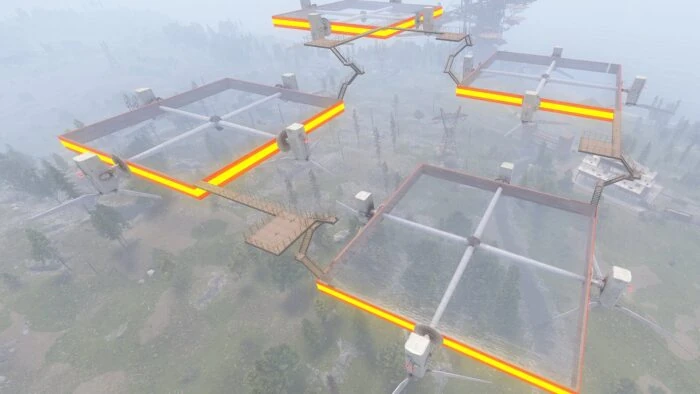
A build zone: somewhere to try a design before a wipe decides whether it works. Air Build Zone.
Where the cupboard goes
The tool cupboard is the actual target. Destroy it and building privilege is gone immediately, and decay starts on the whole base 24 hours later. A raider who reaches your TC has won whether or not they reach your loot.
- Never on an outside wall. Never in the first room.
- Behind honeycomb, so breaching the shell still leaves walls between them and it.
- Not next to your loot. Putting both in one room means one breach takes everything.
The sealed cupboard
The committed version: once the base is finished, you wall the TC into a chamber with no door. Nothing reaches it without explosives — including you, which means you cannot top up the upkeep without breaking in from the inside. Excellent defence, genuine ongoing cost. Decide before you seal it, not after.
Upkeep, which is what actually kills most bases
More bases are lost to decay than to raids, and every one of them was lost by somebody who logged off without topping up.
- Upkeep runs at roughly 10% of the build cost per day, paid out of the cupboard.
- The rate varies by block, from about 10% up to 33%.
- High external walls are the expensive ones: since the Power Trip update they carry a flat 20%, double a normal block.
So a wall of external walls around a small base can cost more to maintain than the base. Build the base you can afford to keep, not the base you can afford to build.
Overfill the cupboard before you log off, every time. It is the cheapest insurance in the game and the most commonly skipped.
The airlock
Two doors with a small space between them. While the outer door is open, the inner one is still closed, so somebody watching your base does not get a free look at everything you own — or a free run inside behind you.
It costs one extra door and one extra square of floor and it is the difference between being raided and being walked in on. Build it on day one.
A 2×1 that does all of it
For a solo, and the base I would tell anybody to start from:
- 2×1 core, upgraded to stone immediately and sheet metal as soon as you can afford it
- Airlock — two doors, small gap
- Honeycomb all the way round, not on one side
- Cupboard walled into the honeycomb, not in the living space
- Garage door on the loot room
- Furnace, boxes and workbench inside, so you never have to leave to process
Cheap to maintain, small enough to honeycomb completely, and it has to be raided twice — once to get in, once to get to the cupboard. That is the whole idea: not that they cannot, but that they will look at the cost and go to your neighbour.
The checklist
- No soft side facing outwards, anywhere
- Stone at minimum, sheet metal as soon as possible
- Honeycomb all the way round, or a smaller base
- Cupboard buried, and not beside the loot
- An airlock
- The cupboard overfilled before you log off
If you are still on day one, the ground before this one is how to survive your first day in Rust PvP. And if you run the server rather than live on it, the map decides how much of this anybody gets to do — that part is what I build.